
Organizations with multiple entities—subsidiaries, divisions, departments, locations, or legal companies—quickly discover that reporting complexity grows faster than the business itself. What starts as a manageable close process often turns into a recurring cycle of exports, spreadsheets, reconciliations, and last-minute fixes.
The problem isn’t your finance team.
Multi-entity reporting is genuinely difficult—especially inside traditional ERP systems.
This article explains why ERP reporting struggles with multi-entity complexity and outlines a proven, scalable way to fix it.
What Is Multi-Entity Reporting (and What Does It Really Include)?
Multi-entity reporting is the process of producing financial reports across multiple companies, departments, or locations while also generating consolidated rollups with consistent definitions, formatting, and access controls.
Multi-entity reporting goes far beyond running a P&L for more than one company. In practice, it means being able to:
- Report financials at any level (entity, department, location, division, region)
- Create consolidated financial statements across ownership structures
- Support multiple charts of accounts, ERPs, and currencies
- Maintain consistent formatting and definitions across every report
- Restrict access so users only see what they’re authorized to see
- Distribute tailored reporting packages automatically
As outlined in our whitepaper, Simplifying Multi-Company Financial Reporting, these challenges are especially common in holding companies, investment firms, and organizations managing independently operated businesses—each with their own systems, policies, and structures.
Why Is Multi-Entity Reporting So Difficult in ERP Systems?
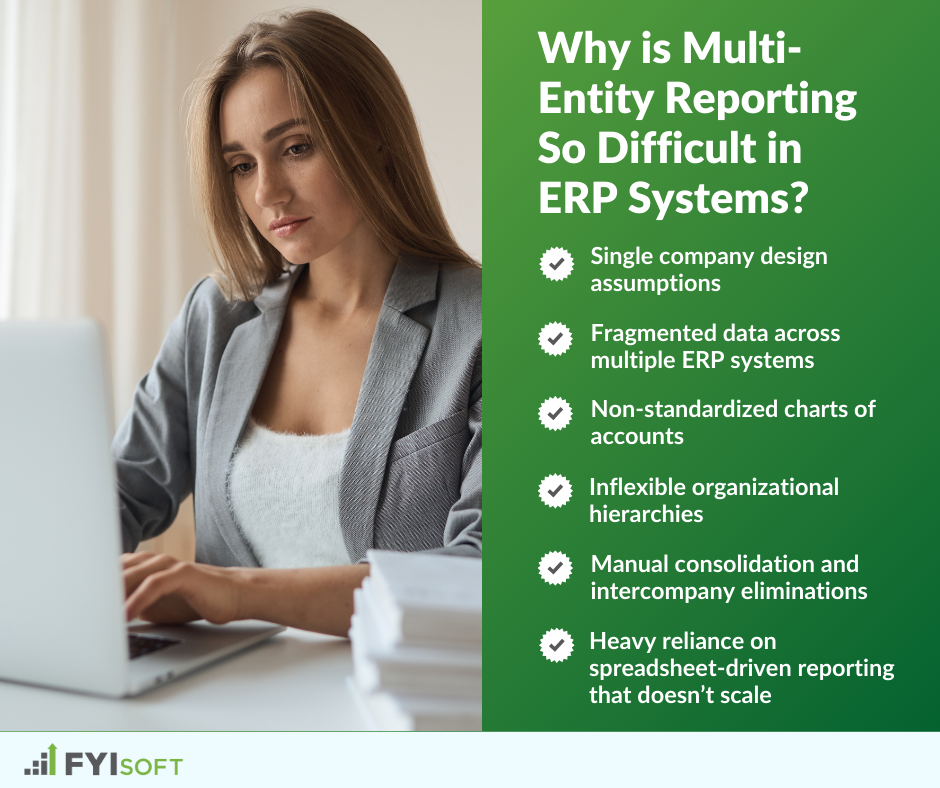
Multi-entity reporting is difficult in ERP systems because most ERPs are designed for single-company environments and struggle with multiple charts of accounts, changing hierarchies, consolidation rules, and multi-currency requirements.
ERP systems are excellent at recording transactions, but reporting across complex organizational structures was rarely their design priority. The most common failure points include:
- Single-company design assumptions
ERP reporting tools are built around one chart of accounts and one hierarchy, making multi-entity reporting rigid and difficult to adapt. - Fragmented data across multiple ERP systems
Acquisitions and global operations often result in multiple ERPs, forcing manual data extraction and reconciliation before reporting can begin. - Non-standardized charts of accounts
Differences in account structures and segment definitions require ongoing mapping and reconciliation, increasing financial close time and error risk. - Inflexible organizational hierarchies
ERP reports are typically hardcoded to fixed structures and can’t easily support changing rollups by region, brand, or ownership group. - Manual consolidation and intercompany eliminations
Consolidation involves more than adding numbers and often relies on spreadsheets to handle eliminations, ownership adjustments, and currency translation. - Spreadsheet-driven reporting workflows that don’t scale
As the number of entities grows, spreadsheets introduce version control issues, slow performance, and declining confidence in reported results.
How Can Organizations Fix Multi-Entity Reporting Without Replacing Their ERP?
Organizations can fix multi-entity reporting without replacing their ERP by adding a purpose-built reporting layer that standardizes data, automates consolidation, and supports flexible hierarchies.
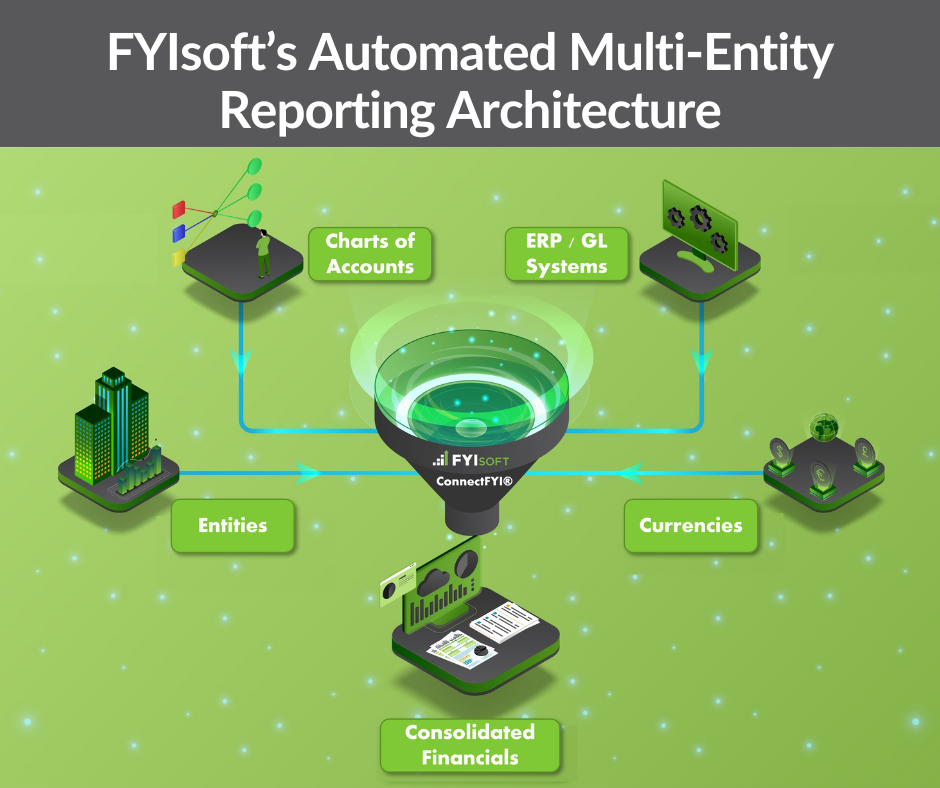
This approach preserves existing ERP investments while removing reporting bottlenecks. A purpose-built multi-entity reporting architecture like FYIsoft’s includes:
- Standardized data across all entities and ERPs
Through FYIsoft’s ConnectFYI technology, financial data is extracted from one or many ERP systems and transformed into a consistent reporting structure, regardless of underlying charts of accounts or currencies. - Organization trees for flexible rollups and filtering
Entities, departments, and locations are organized into reusable hierarchies that automate rollups and allow easy, flexible reporting by any management view. - Automated consolidation and currency translation
Consolidations, intercompany eliminations, and currency translation are handled systematically, eliminating manual spreadsheet processes. - Automated report generation and secure distribution
Financial statements and reporting packages are generated automatically and distributed with role-based security so each stakeholder sees only what they’re authorized to view.
How Do Organization Trees Improve Multi-Entity Reporting?
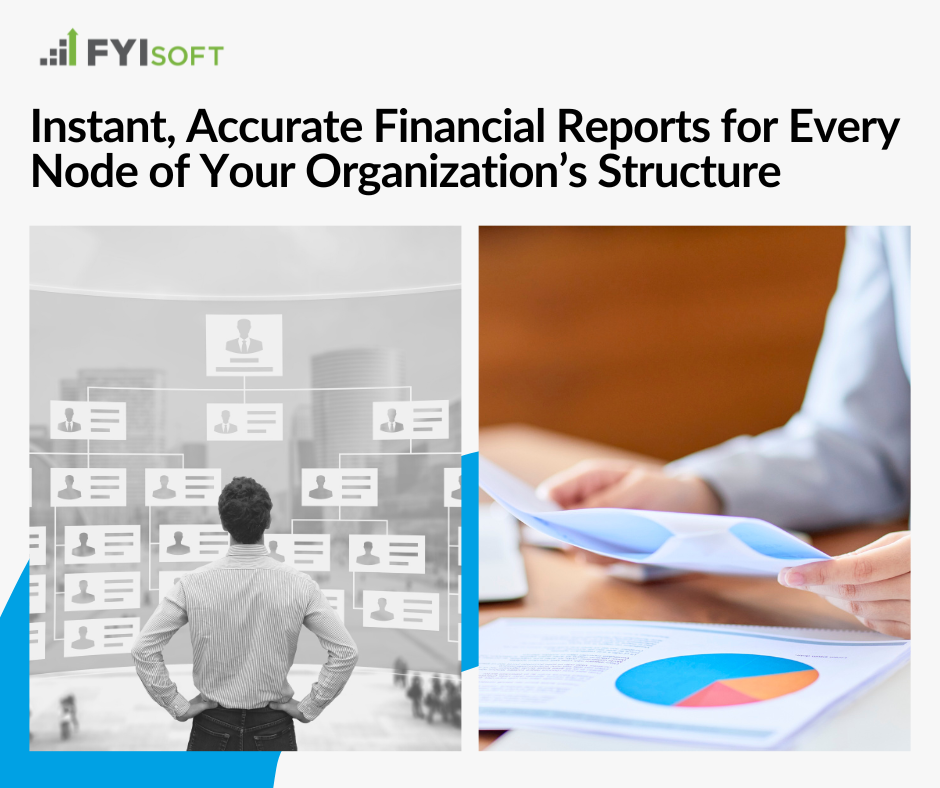
Organization trees built into FYIsoft’s reporting software improve multi-entity reporting by defining how entities, departments, and locations roll up, enabling automated consolidation, simple changes, and flexible filtering without rebuilding reports.
Hierarchy structures are often hardcoded into ERP reports. When that structure changes, every report impacted must also be changed, which is a highly manual and time-intensive process. FYIsoft’s approach is different. Instead of hardcoding hierarchies into reports, organizational trees allow finance teams to:
Reuse the same reports across different rollups
Instantly change report structures or reporting views with drag-and-drop ease
Automate entity-level and consolidated reporting
This explainer video provides more insight into the time-saving benefits of the organizational tree structure.
What Is the Best Long-Term Approach to Multi-Entity Reporting?
The best long-term approach to multi-entity reporting is automation—standardizing data once, defining reusable hierarchies, and eliminating manual consolidation work.
Multi-entity reporting doesn’t fail because finance teams lack skill. It fails because ERP reporting tools weren’t designed to handle unlimited organizational complexity.
FYIsoft was.
With unlimited entity, department, and location structures, consolidated through organization trees that automate rollups and filtering, FYIsoft enables finance teams to deliver faster closes, consistent reporting, and scalable insight—without spreadsheets or ERP constraints.
Ready to simplify multi-entity reporting?
Learn more about FYIsoft’s:
Or schedule a demo to see how automated organization trees transform reporting at any scale.
Frequently Asked Questions
Multi-entity reporting is the process of producing financial reports across multiple companies, departments, or locations and generating consolidated rollups with consistent definitions and formatting.
Most ERP systems are designed for single-company reporting and struggle to handle multiple charts of accounts, changing hierarchies, intercompany eliminations, and multi-currency consolidation.
Multi-entity consolidations break down as a result of manual processes, spreadsheets, inconsistent account structures, and fragmented data across multiple ERPs cause delays, errors, and unreliable consolidated financial statements.
Organization trees built into FYIsoft’s reporting software define how entities and departments roll up, allowing automated consolidation, flexible filtering, simple changes, and reusable reporting structures without rebuilding reports.
Companies can quickly fix multi-entity reporting challenges by adding a reporting platform such as FYIsoft’s that standardizes data across ERPs, uses organization trees for rollups, and automates consolidation and report distribution.