
Where AI in Finance ROI Actually Comes From
AI in Finance ROI comes from measurable improvements in efficiency, forecast accuracy, margin protection, and working capital visibility. With the strategic use of AI, CFOs can see 25–40% time savings in analysis, 15–30% improved forecast reliability, and faster board reporting cycles — often achieving payback within 6–12 months when implementation is disciplined.
AI in Finance: How CFOs Evaluate ROI, Risk, and Real Business Impact
If you’re like most CFOs, you’re probably not asking whether AI is “the future.”
You’re asking something much simpler:
Is this actually worth it for my finance organization?
You don’t need hype. You need clarity. You need to understand where AI in finance delivers measurable ROI — and where it doesn’t.
Let’s walk through that together.
What AI in Finance Really Means (And What It Doesn’t)
Before we talk about value, it helps to define terms.
When we talk about AI for finance teams, we’re usually referring to systems that can:
- Analyze large volumes of financial data
- Identify patterns and anomalies
- Automate repetitive tasks
- Generate forecasts or insights faster than manual processes
This isn’t about replacing your team. It’s about augmenting them.
It’s not about robots running the close.
It’s about giving your team back time — and giving you better visibility.
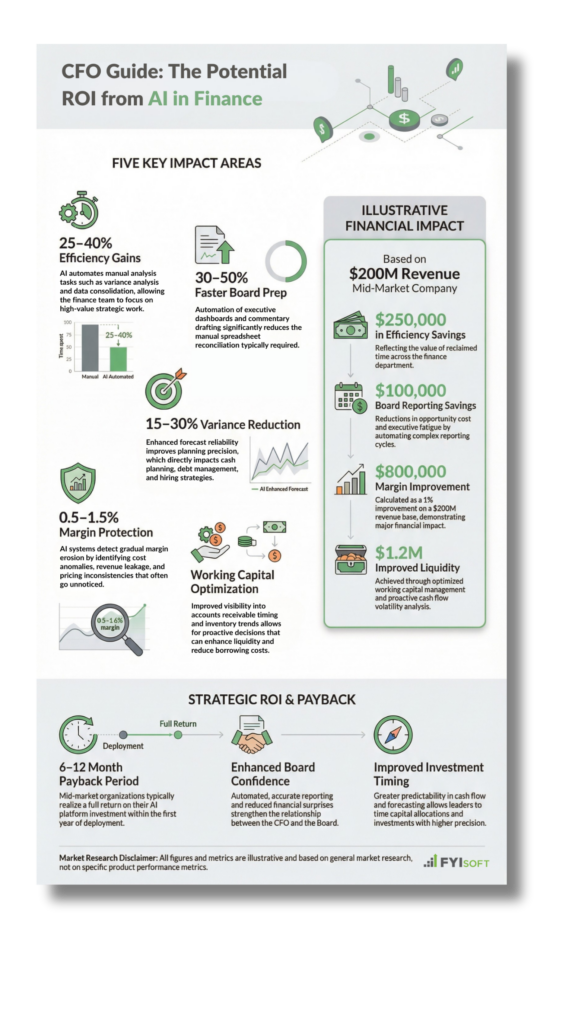
Download the Infographic
The Core Question: Where Is the ROI?
Here’s the short answer:
AI in finance delivers ROI when it reduces manual work, improves forecasting accuracy, shortens reporting cycles, or identifies financial risk earlier than traditional processes.
That’s it.
If it doesn’t move one of those levers, it’s probably not worth your time.
For most finance organizations, ROI shows up in three measurable areas: efficiency, accuracy, and decision support.
- Efficiency: Freeing Up Finance Talent
Your team didn’t train for years to manually reconcile accounts or chase spreadsheet errors.
Yet many finance departments still spend 60–70% of their time on transactional, repetitive tasks.
AI-driven automation can reduce time spent on:
- Account reconciliations
- Journal entry reviews
- Invoice processing
- Data consolidation for reporting
The financial impact is straightforward:
- Faster month-end close
- Lower overtime costs
- Ability to scale without adding headcount
But the deeper ROI is strategic.
When your team spends less time preparing numbers, they spend more time analyzing them.
That shift matters.
- Accuracy: Reducing Risk and Costly Errors
Errors in financial reporting are expensive. Sometimes financially. Always reputationally.
AI systems excel at pattern recognition. They can flag anomalies across millions of transactions — something no human team can do at scale.
For CFOs, that translates into:
- Earlier fraud detection
- More reliable forecasting
- Fewer reporting surprises
- Improved compliance confidence
Even a modest reduction in error rates can protect significant enterprise value.
And unlike additional manual review layers, AI scales without fatigue.
- Decision Support: From Reporting to Insight
This is where AI becomes strategic rather than operational.
Traditional finance systems tell you what happened.
AI-enhanced systems can help you model what might happen next.
That includes:
- Cash flow forecasting with scenario modeling
- Predictive revenue trends
- Expense pattern analysis
- Working capital optimization
For you as CFO, this means moving from backward-looking reporting to forward-looking insight.
Not guesswork. Not magic. Just better use of your data.
A Quick Reality Check: Where AI Doesn’t Deliver
It’s important to say this clearly.
AI is not a silver bullet.
If your data is inconsistent, fragmented, or unreliable, AI will amplify those issues.
If your workflows are undefined, automation will simply accelerate confusion.
And if the goal is vague — “we should be using AI” — ROI will be equally vague.
The strongest outcomes happen when AI is applied to clearly defined financial processes with measurable targets.
How CFOs Are Adopting AI
Across mid-sized and enterprise finance organizations, most AI adoption follows a similar path:
They start small.
Instead of transforming the entire department, they apply AI to one high-friction area — often:
- Accounts payable automation
- Forecasting improvements
- Anomaly detection in transactions
They measure impact carefully.
Then they expand.
This phased approach lowers risk while building internal confidence.
How to Evaluate AI ROI in Your Finance Organization
If you’re considering AI for your team, ask four direct questions:
- Where are we spending the most manual effort?
- Where do errors or delays create financial risk?
- Where do we lack forward-looking visibility?
- Can we quantify the time, cost, or risk reduction?
If you can tie AI to a measurable improvement in one of those areas, the case becomes clear.
If not, it may not be the right moment.
The Bigger Picture: Control, Not Disruption
For many CFOs, the hesitation isn’t about technology.
It’s about control.
Finance is the backbone of the organization. Stability matters. Precision matters.
AI doesn’t replace that discipline. It can strengthen it.
When implemented thoughtfully, AI in finance increases transparency, not opacity.
It reduces fire drills. It improves audit readiness. It enhances decision quality.
The goal isn’t disruption.
It’s control at scale.
So… Is AI Worth It for Your Finance Team?
If you’re expecting a dramatic overnight transformation, probably not.
If you’re looking for incremental, measurable improvements in efficiency, accuracy, and insight — then yes, AI can absolutely deliver ROI in finance.
But only when applied with discipline.
The smartest CFOs aren’t chasing trends.
They’re asking practical questions. Running controlled pilots. Measuring impact. Expanding intentionally.
That’s not hype.
That’s financial leadership.
Final Thought
As CFO, you don’t need to become a technologist.
You need to remain what you already are: a steward of capital, risk, and long-term value.
AI in finance isn’t about being innovative for innovation’s sake.
It’s about strengthening the function you already run — with better tools.
And if it can help your team close faster, forecast better, and reduce risk more consistently, that’s not hype.
That’s return on investment.